
|
Career CPR: Michael KeatonBy Reagen SulewskiNovember 14, 2002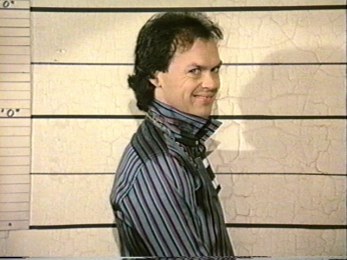
When you talk about actors that have seemingly disappeared in the last five years, it's difficult to think of a better example than Michael Keaton. Although he was nearly ubiquitous in the 1980s and early '90s, it's like he suddenly stopped even wanting to make movies. He definitely passes the "Whatever happened to...?" test; mention his name in casual conversation and you're sure to get that sentence tossed back at you. Even though he's never really had tremendously successful films, other than the two Batman movies, he's an actor that most people seem to like. Why then, has he not appeared in a movie that got even a token wide release in North America since 1998? After working in a variety of TV jobs, Keaton got his big break in 1982 in Ron Howard's Night Shift, stealing the movie out from under Henry Winkler. Outshining The Fonz in a movie in the early '80s has to be considered a feat on the same level as being funnier than Adam Sandler in one of his vehicles (though your mileage may vary), so it's easy to see why his career got to where it did. Shortly thereafter he got his first lead in Mr. Mom, with its gender politics such a product of its time that it's surprising that it even got a DVD release. However, Keaton displayed great comedic skills and his career path continued upwards. Following a gangster spoof (Johnny Dangerously, which developed a cult following), a second go-round with Ron Howard, a largely forgettable romantic comedy and a comedy thriller about the New York state lotto for which its producers would have been better off spending the budget on actual lotto tickets, Keaton needed a boost. In 1988-90, he entered what can only be considered his golden period, including his first outright brilliant performance. As the title character in Tim Burton's Beetlejuice, he was manic, energetic, psychotic and, well, just ick. As funny as any performance Jim Carrey has ever given, this was the counterpoint to some of his Ordinary Joe roles such as the one in Gung Ho. Clearly he's a versatile actor, and proved it further that year with Clean and Sober, about as far as you could get from Beetlejuice but still maintaining his trademark edginess. As a real-estate salesman who checks into a rehab center, Keaton probably came the closest he ever did to an Oscar nomination. Unfortunately, the film only earned $8 million at the box office, chump change even for 1988. You can see how a person could get bitter. Tim Burton came to the rescue again, as he cast Keaton as the Caped Crusader in his big-budget adaptation of Batman. Easily one of the most controversial castings for a comic-book movie ever, the decision to put Keaton in the title role was met with violent opposition. Too short, they said (though at 5 foot 10, he's taller than many leading men in Hollywood). Not physical enough. Not manly enough. Hey, considering other actors who were considered big stars at the time, we're lucky we didn't get Patrick Swayze as Batman. Once the film opened, Keaton was vindicated, as most people realized that Batman, played properly, is mostly an attitude anyway. Although he didn't get rich like Jack Nicholson did from the project, he should have been able to write his own ticket from then on. Whether he did or not is between him and his agent, but one thing that's clear when looking over his CV is that he doesn't have a great eye for hits. His record through the '90s is like a tour through the Underachieving Films' Hall of Fame. First after Batman came Pacific Heights, featuring Keaton's first out-and-out villain (I wouldn't call Beetlejuice a villain per se; it's too comical for that). A mediocre thriller about property ownership, it failed to inspire much of anyone, earning only $28 million. Considering it co-starred then-big names Matthew Modine and Melanie Griffith (ah, those wacky late '80s/early '90s), this had to be a major disappointment. This was simply a warm-up though, as 1991 brought One Good Cop, a sentimental thriller (two words that just don't go together) that took in only $11 million. A second go in the Batman franchise with 1992's Returns was like slapping a Band-Aid on a heart attack; his reputation as box office poison was quickly beginning to set. This was probably no clearer than with his 1993-94 trilogy of largely-forgotten bombs My Life, Speechless and The Paper, the latter notable for being Keaton's third collaboration with Ron Howard (catching Howard on one of his rare flops). Probably the best of the three was My Life, which had him as an expectant father who learns he has cancer and will die within months. Touching without becoming maudlin, Keaton does a great job in transforming from a cold yuppie to a charming family man. However, keeping in his trend of flops, it earned only $28 million. Suddenly, a public that before couldn't believe him as a choice for Batman now couldn't buy him as anything but. Taking into consideration his rapidly increasing typecast nature, passing on 1995's Batman Forever seemed the smart thing for Keaton to do (in retrospect a very smart move, no matter the payday). He was then left without a film for that year. No problem, if the upcoming film is worth waiting for. Unfortunately, the result was 1996's Multiplicity. With its Groundhog Day-quality of high concept involving cloning, it appeared to be just the thing to shake out the doldrums of his career. Too bad that the discussions regarding cloning that the film inspired were far more involved than the film itself, which satisfied itself with being a big Three's Company episode. A surprising botch by Harold Ramis, it ironically showcased some of Keaton's best work, being something of a microcosm of his previous roles. Here was Keaton the Everyman, Keaton as Gruff Machismo, Keaton the Sensitive Male and Keaton the Clown. The box office was also a microcosm of Keaton's previous films, bombing out at $20 million. Keaton's bad luck with directors continued, catching Quentin Tarantino on his downswing with Jackie Brown, playing FBI agent Ray Nicolette. His highest-grossing non-Batman film of the '90s at just under $40 million, it certainly wasn't a bad move, as his character was one of the more entertaining parts of the film; however, it wasn't the hit he needed. The truly awful Desperate Measures followed shortly after (with yet another top-notch director letting him down in Barbet Schroeder). As a true psychopath, this could have been a chance for him to establish a Hannibal Lecter-like presence. He almost does it, too, but the film falls apart completely with its moronic execution of its premise (Andy Garcia's police officer character risks lives to secure a bone-marrow donation for his son from Keaton's cold-blooded killer). As with many of Keaton's other roles, you can see what attracted him to the role; in addition to playing badder-than-bad, the premise has the possibility of raising complex moral issues. Too bad it was just an excuse for some stunts and explosions. The result was one of his worst box office showings ever. His last appearance on major numbers of North American screens was in December of 1998, with the inexplicable Jack Frost. One can only hope this was a "make something for my kids" kind of role. Then again, since he physically was only in a small part of the movie and spent the rest as the voice of a reincarnated snowman (!!), he probably made a good paycheck for not too much work. Belonging to the annals of horrific children's entertainment, along with films like Baby Geniuses, See Spot Run, and Mac and Me, Jack Frost was saved from total failure by its Christmas release time, and now exists mostly to confuse parents into renting the horror film of the same name about a killer snowman. Keaton's film makes people want to kill themselves, so same difference, really. Since then, his credits have ranged from non-existent to non-evident. A Shot at Glory had him as the American owner of a Scottish football team. The IMDb claims it had a release in May of this year, but what it made obviously wasn't worth reporting. The Mark Knopfler soundtrack undoubtedly sold more copies than people saw the movie. There was also Quicksand, with Michael "I'll Play Anything" Caine, which had him as a bank executive framed for embezzlement. Still awaiting release anywhere in the world, apparently, Quicksand, along with the previously-mentioned film, announces Keaton's new status as a straight-to-video actor, along with such luminaries as Rutger Hauer and Treat Williams. From Batman to snowman. From blockbusters to Blockbuster. Everyman to no one. The fundamental problem appears to be how of a time and place that Keaton was; as the quintessential yuppie, he was perfect as '80s Man, fighting against the system. Once the clock ran out on those films, he was left without a hook as an actor, despite his being one of the more intense actors in Hollywood. A lot of people would blame this all on passing on Batman, but really, his fate was almost sealed when he first took on the role. He somehow failed to carve out a new identity for himself before the opportunity was lost. At this point, I'm wondering if the whole thing doesn't stem back to losing Courtney Cox to David Arquette. Nobody could respect himself after that. My advice to Michael: Contact M. Night Shyamalan quick; you probably wouldn't get the lead role in his next film, but there's no reason you couldn't get something like the Joaquin Phoenix role in Signs (of course with your luck with directors, it'll be the film where the Shyamalan backlash kicks in). Or you could change your name back to Michael Douglas and let the confusion bring you some of his scripts (you might also catch a confused Catherine Zeta-Jones unaware). One thing though; if you ever even look at a script titled Jack Frost 2, I'm disowning you forever.
SummaryAge: 51Best at Playing: Everymen, unrepentant psychos Most Famous For: Batman Best Role You Probably Missed: Much Ado About Nothing Point When Even His Biggest Fans Knew Something Was Very, Very Wrong: Jack Frost Upcoming Role That Should Have Been His: The Ray Liotta part in Narc. Is it fair to steal from another actor who's also been outside of leading roles for the past few years? Probably not, but I think that this role as an intense, brooding cop out for revenge for his partner's death would have been a terrific way for Keaton to get back on top. |
Wednesday, June 10, 2026
© 2006 Box Office Prophets, a division of One Of Us, Inc.
