
|
Naqoyqatsi and the Qatsi TrilogyBy Tad RoebuckOctober 21, 2002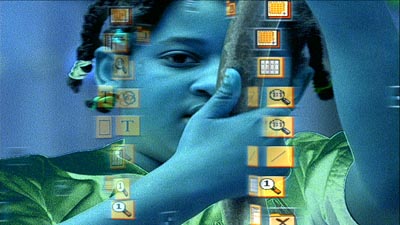
Naqoyqatsi is the third film in Godfrey Reggio's Qatsi trilogy, which was born when 1983's stunning Koyaanisqatsi met with the kind of quiet popularity that serves to rescue the occasional masterpiece from art house obscurity. "Qatsi", in the tongue of the Hopi Indian, means "life", and the titles roughly translate into Life Out of Balance, (Koyaanisqatsi) Life in Transformation, (1987's Powaqqatsi) and Life as War (Naqoyqatsi). In the interest of fairness and full disclosure, I have to state up front that I am approaching this review with an unusual amount of respect for Reggio's work. I saw Koyaanisqatsi when it was first released, back when I was a young, impressionable high-schooler. I left the theatre a changed person, fully aware that I had just experienced a profound, fundamental shift in my perception of the world. I can't say that a film has ever had such a singular effect on me before or since, and each time I have seen Koyaanisqatsi in the intervening years, it has always served as something of a reality check. Ask any person who has seen the Qatsi films what they are about, and they might say things like, "It's about the world moving faster than our ability to keep up with it"; or "It's about the consequences of man's conquest of nature"; or "It's about how technology has evolved and eclipsed our humanity." Ultimately, they will tell you, "You just have to see it." That answer is due, partially, to the fact that there is nobody around in these films to tell you what to think about them. No story, no plot, no dialogue, no narration of any kind; rather, the film is a poetic, impressionistic series of images grabbed from the world around us, fused with music. What those elements ultimately add up to depends very much on what the viewer brings to the theatre... The quality of the experience - and it IS an experience - occurs almost entirely in the interaction between the viewer and what the images represent to that viewer. None of this makes the job easy on the marketing and publicity people at Miramax, the studio behind Naqoyqatsi, and I can't say that I envy them. First, there is the problem that just about everyone has been trained to watch movies a certain way. You sit down and are led, with varying degrees of skill, through plot and character exposition, conflict, rising action, denouement and resolution. That's the way it's always been, that's the way most people like it, and for the people who want and expect such things, the Qatsi films have absolutely nothing to offer. Then, for the remaining audience, there is the challenge of actually trying to describe the film to them. The trailer for Naqoyqatsi admonishes, "There is No More Nature. There is Only Technology. Everyday Life is War." The movie poster cries: "America is Test Driving the Future." Some powerful language indeed, guaranteed to scare off just about anyone who doesn't enjoy a good didactic clubbing over the head every now and then. That's a shame, because like its predecessors, Naqoyqatsi refuses to lecture so directly on such things. This is not to say that the filmmakers have no editorial stance, no point of view; as the subtitle of this latest installment, Life as War, will attest. But even that subtitle is misleading, as Naqoyqatsi is not the extended meditation on mass human conflict (metaphorical or otherwise) that one might expect. While the theme of war is certainly touched on, it was also explored quite effectively in the first film. Indeed, Koyaanisqatsi seemed to present such an extraordinarily broad range of experiences representative of life on this planet that one might have been justified in thinking that a sequel, much less a trilogy, would be a moot point. Just what else is left to discuss? Well, as it turns out, Koyaanisqatsi was focused mainly on life in North America. There is a much larger, developing world out there, and that world is full of indigenous people and traditions being edged out by technological "progress" and cultural imperialism. That was a theme hinted at in the very first and very last shots of Koyaanisqatsi, but it is covered in much more detail by the globe-trotting Powaqqatsi. While that film at times feels like it has to work to avoid looking too much like its predecessor, it is still a sensuous and captivating experience. I was elated to hear that, nearly two decades after the first film, the Qatsi series would be fleshed out into a trilogy. But even though the world has changed so much since Powaqqatsi - hell, since last year - I still had to wonder just what Naqoyqatsi could possibly do to differentiate itself from its older siblings. It's worth mentioning at this point that it really doesn't matter if you haven't seen the first two films; Naqoyqatsi is a gorgeous achievement that absolutely deserves to be seen. In fact, you are probably in a better position to enjoy Naqoyqatsi, since you will not be bringing with you the extraordinarily high expectations set by Koyaanisqatsi and Powaqqatsi. Those who have seen the first two films will find that Naqoyqatsi serves less as a distinct third chapter bringing closure to a trilogy and more as a companion piece to the previous films. There are indeed some new explorations of the human form, of medicine, of competitive sports. And unlike the first Qatsi films, the images in Naqoyqatsi are comprised almost entirely of stock footage, some of which has actually already appeared in Koyaanisqatsi. This footage, however, is manipulated with myriad state-of-the-art techniques, essentially making Naqoyqatsi one long, 90-minute special effect. While the previous films relied on the innovative use of more organic film effects like stop-motion photography and slow motion, Naqoyqatsi relies extensively on recent developments in computer imaging and animation. Perhaps that's the most useful way to visualize the idea that the building blocks of the future are zeros and ones, the binary code of digital technology. But this film's complete and utter reliance on computers only serves to reveal an ambivalent stance; is Naqoyqatsi rejecting technology or actually embracing it? Regardless, audiences will marvel not only at the beauty of the images, but at the meticulous skill, craft - and yes, the technology - that brings those images to the screen. While it's the images that bring people into the theatres, these films are very much a shared effort between Reggio and Philip Glass, the composer who has scored all three films. Glass is a master of the art of collaboration; in his work with Ravi Shankar and Foday Suso, for instance, it is nearly impossible to discern Glass' contribution from that of his collaborators. So, too, Glass seamlessly, exquisitely laces Reggio's images with his own particular sense of awe, of sorrow, of beauty and of despair. The interplay is a process of continual cross-pollination that is always a joy to experience, and with Naqoyqatsi, Glass has once more contributed an extraordinarily brilliant work. Yo-Yo Ma's cello widens the circle of collaboration, and again, it is impossible to discern where Glass ends and Ma begins. Glass and Reggio talk at great length about their collaboration in interviews that are featured on the newly-released DVDs of Koyaanisqatsi and Powaqqatsi. I was ecstatic at the news of their arrival to DVD; these films are an utterly essential acid test for anyone who wants to experience the full capabilities of their home entertainment system. But then a brooding sense of cynicism crept in...that these DVDs hit the shelves just before the release of Naqoyqatsi is no coincidence, to be sure. You can even buy them both wrapped together with a cardboard band, which tells you just what a "Spectacular Value!" the two-for is. All of this smacks of the very kind of synergistic strategizing and market campaigning that the Qatsi films seem to suggest (in their own quiet, non-judgmental way) is one of the forces that works to throw life out of balance. At the risk of sounding precious, it somehow feels as if something pure in the film world is being sullied; if you felt a slight sinking feeling when you first heard The Clash in a Jaguar commercial, then you know what I'm talking about.
|
Monday, June 08, 2026
© 2006 Box Office Prophets, a division of One Of Us, Inc.
